
Sailboat Racing has given me so many leadership lessons of the years
I have been racing small sailboats since 1986, most recently in the 17-foot, sloop-rigged Thistle, and over time I have come to see clear parallels between what happens on the water and what effective leadership requires. The environments may differ, but the underlying dynamics such as teamwork, unpredictability, decision-making under pressure, and the need to balance detail with perspective, are remarkably similar.
Sailboat racing is often viewed as an individual or purely competitive sport. While competition is certainly central, including positioning at the start, managing wind shifts, and making tactical decisions, success in a small boat depends fundamentally on collaboration. Each person on board, whether skipper or crew, has a defined role, yet those roles must function in complete alignment. Communication must be precise, and trust must be implicit. Even small lapses in coordination are immediately visible in performance.
This dynamic closely reflects strong leadership environments. Effective leaders do not simply direct; they create clarity, alignment, and shared purpose. When individuals understand both their responsibilities and the broader objective, they are better positioned to act decisively and cohesively. Leadership, in this sense, is less about control and more about enabling coordinated execution.
Another important lesson from small boat racing is the impact of small mistakes. In a 17-foot sailboat, minor errors such as an imperfect tack, a poorly timed maneuver, or a subtle misreading of the wind, can have major consequences. At the same time, many of these errors are preventable through careful preparation. Equipment checks, course awareness, and pre-race planning all contribute to minimizing avoidable risk.
The same principle applies in leadership. Challenges are often not the result of major failures, but rather the accumulation of smaller oversights such as unclear communication, insufficient preparation, or missed signals. While perfection is not attainable, disciplined attention to fundamentals significantly reduces the frequency and impact of these issues.
Even with strong preparation, however, uncertainty remains. In sailing, wind conditions are inherently variable. Shifts can occur suddenly, driven by factors beyond immediate visibility or control. A well-executed plan can quickly become obsolete, while unexpected opportunities can emerge just as rapidly. Recently friends were racing their Thistle at a major event when a military jet took off and flew right over them, rapidly causing them to capsize, twice. None of us had seen this before, and yet once all the competitors realized the risk, we learned to avoid the area near that airport to avoid getting caught in the vortexes caused by these jets.
This unpredictability mirrors the broader economic and organizational landscape. External conditions evolve, sometimes without warning, requiring leaders to remain adaptable. Everything from unexpected tariffs to wars can affect our businesses. The most effective leaders, like experienced sailors, focus less on trying to control these forces and more on interpreting and responding to them. Flexibility, situational awareness, and a willingness to adjust course are essential.
Equally important is maintaining the right perspective. Sailing demands attention to detail including sail trim, balance, and timing, but excessive focus on these elements can lead to a loss of situational awareness. It is possible to become so absorbed in optimizing internal factors that one fails to recognize larger developments, including significant risks such as ships in a shipping channel.
Leadership requires a similar balance. While operational details matter, they must be viewed within a broader strategic context. Leaders must be able to shift between close attention and wide-angle perspective, ensuring that immediate execution aligns with longer-term direction. The ability to “look up” and reassess is critical to avoiding larger missteps. Don’t get so caught up in the details of the business that as a leader we forget to keep sight of long term goals and larger concerns.
One of the most valuable aspects of sailboat racing emerges after the race concludes. Despite the intensity of competition on the water, in the Thistle fleet, the post-race environment is typically collaborative and constructive. Sailors share observations, exchange insights, and discuss both successes and areas for improvement. The emphasis is not on assigning blame, but on learning. More experienced sailboat racers offer advice and feedback to newer sailors as part of the post-racing socials. And all the top-level sailors are welcoming to new sailors. This transfer of knowledge helps everyone become better such that middle level finishers of 20 years ago are now the champions of today.
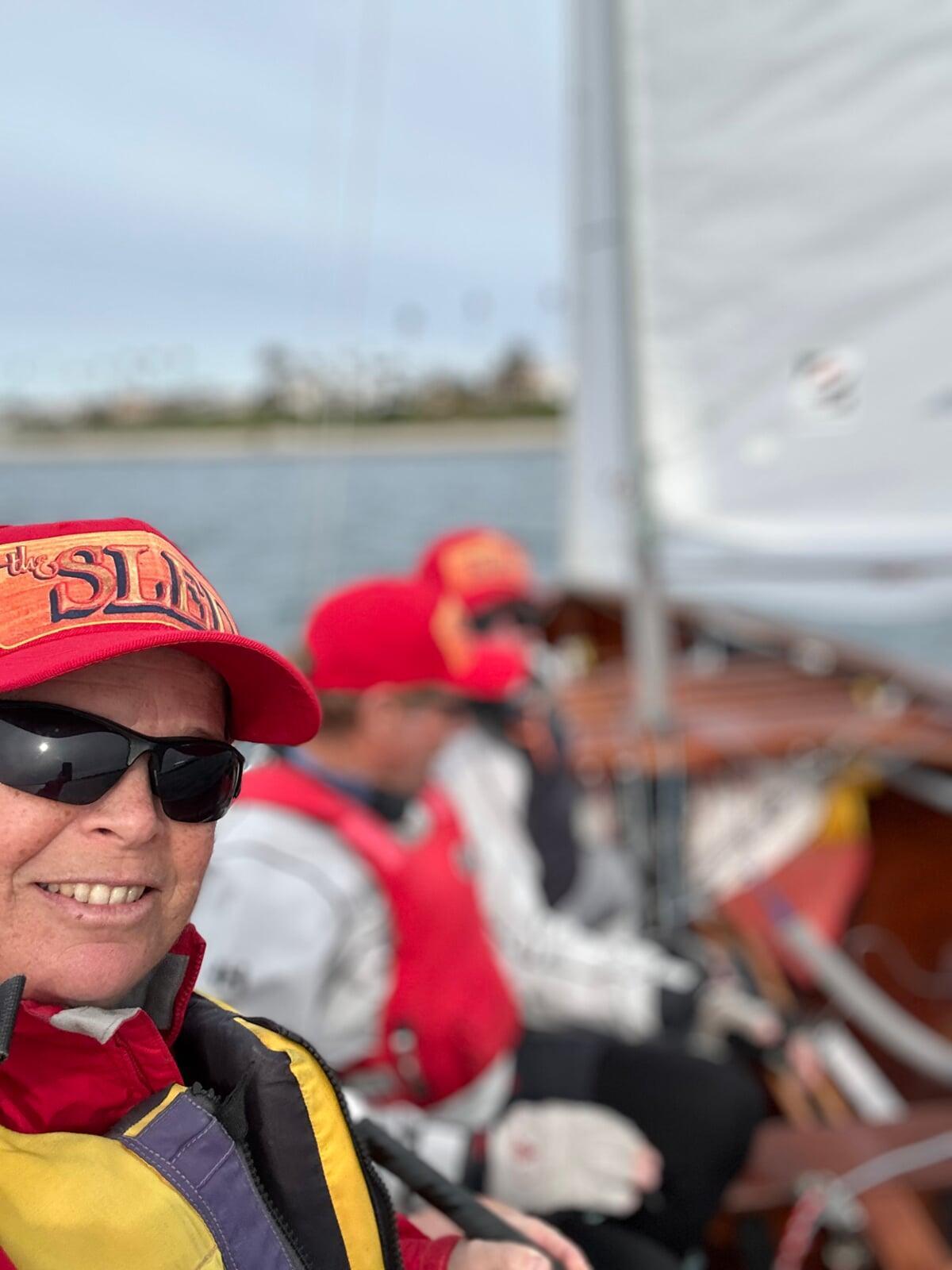
This approach offers a useful model for leadership, especially in small businesses. Focusing only on mistakes or prolonged criticism is rarely productive. More effective is a reflection on outcomes and identifying what worked, understanding what did not, and determining how to improve. Participating in events and forums where leadership concerns can be discussed can provide constructive feedback and ideas for future improvements. This knowledge transfer, similar to sailboat racing, combined with a forward-looking mindset, allows leaders to continuously grow and develop.
Over time, this process builds capability. Each race contributes to a broader accumulation of experience, sailors at the back of the fleet move up towards the front because of incremental improvements leading to stronger overall performance. Leadership benefits from the same perspective, viewing each outcome as part of an ongoing process rather than a final verdict.
Sailboat racing reinforces that leadership is not about achieving perfect control, instead understanding that the sailboat that makes the least mistakes wins. Effective leadership comes from preparation, adaptability, awareness, and trust. Leadership requires attention to detail, balanced by an understanding of the broader environment. And perhaps most importantly, it depends on fostering a culture where everyone can learn from experience, support one another, and continue improving, regardless of how wind and water conditions evolve.
(Previously published on LinkedIn on 3/26/2026)